

“You have shown me a strange image, and they are strange prisoners.” — Glaucon
“Have a sense of humor about things. You’ll need it.” — Anthony Bourdain
You can point yourself at the truth long before you can see it. That’s really the entire reason I got anywhere armed with only a YouTube Premium subscription and pride that had fermented into anger and been rebottled as determination. Which was as much comfort I could alchemize against the fact I was a hostage with a study plan.
“So, what brought you here?”
”Well… I learned lineage because nobody could tell me which inbox, phone, shared drive, or cursed legacy system a record crawled out of. Lawyers will eventually ask, “How do you know?” and “this appears to be the final file” isn’t legally defensible to the DOJ”.
Instead: “I love being a detective.”
Polite. Uncomplicated. Gutless. Happens to the best of us, and they’re lying if they pretend otherwise.
The stakes were high, but the stack was garbage.
Excel and Relativity. Power Query, VLOOKUP, XLOOKUP, and whatever knots of SQL Relativity would let us tie through brittle portals. Reconciliation by hand. Vendor teams who had somewhere better to be. Compliance-grade tools that couldn’t be modded to run a simple spell check which triggered fresh side quests to explain why John Doe with one space was the same batch of evidence as “John Doe” with two. Oh, you ran a boolean search to catch it? Cute. Microsoft Purview extracts them into two completely different pathways and now you’ve doubled your timestamp wrangling, because it’s still one person with three devices hopping between Outlook, Teams, WhatsApp, iMessage and SMS. Ha. Ha. Ha.
Then there’s the senior leader who tells you to just Google it. They’re describing an internet they last used seriously around 2013, when the first result was plausibly the best answer rather than the one that gamed the ranking hardest. They’re also standing on a decade of solved problems and colleagues who told them which results to ignore, none of which is visible to them and all of it is missing for you. “Google it”, they say, cheerfully.
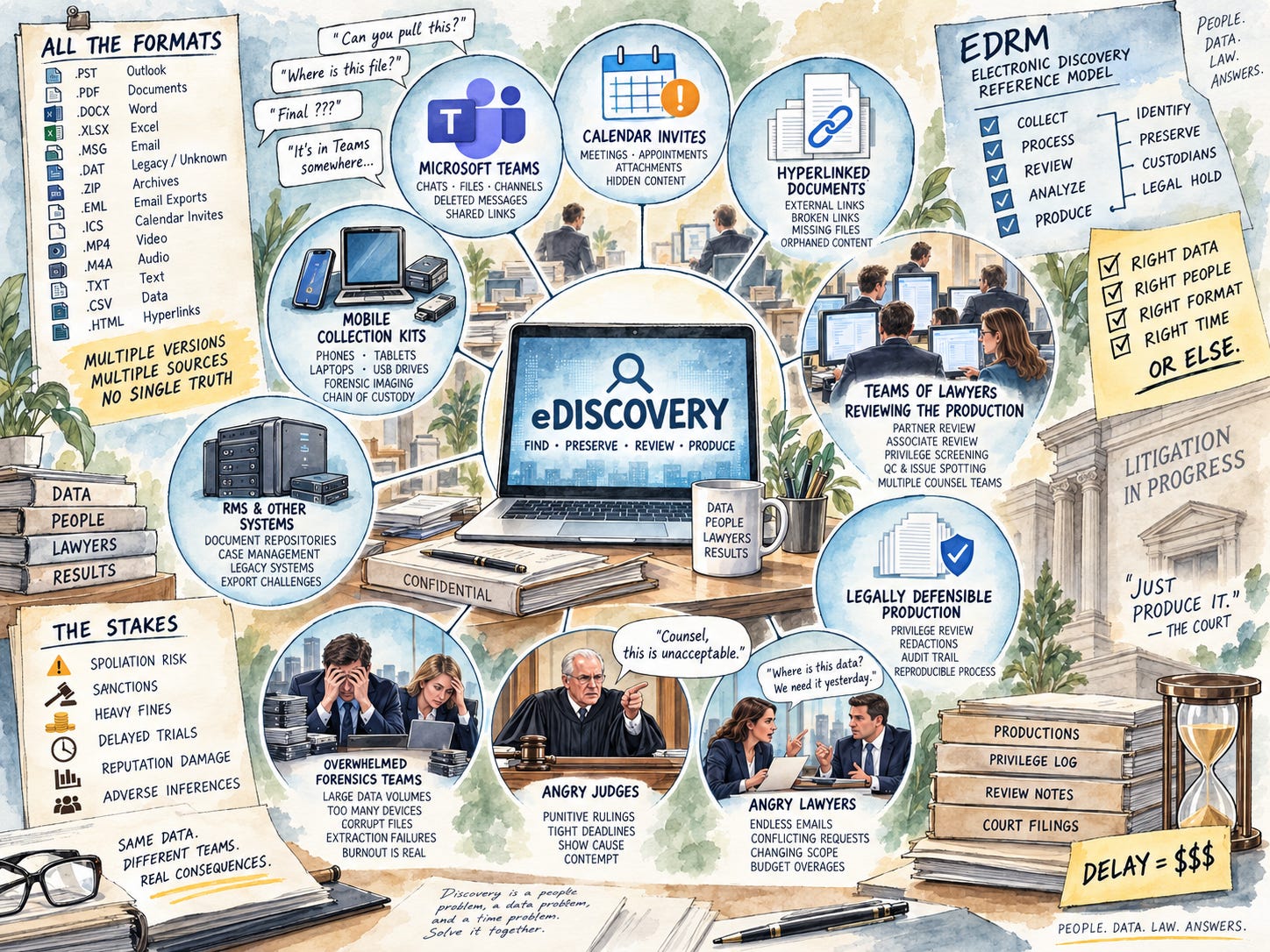
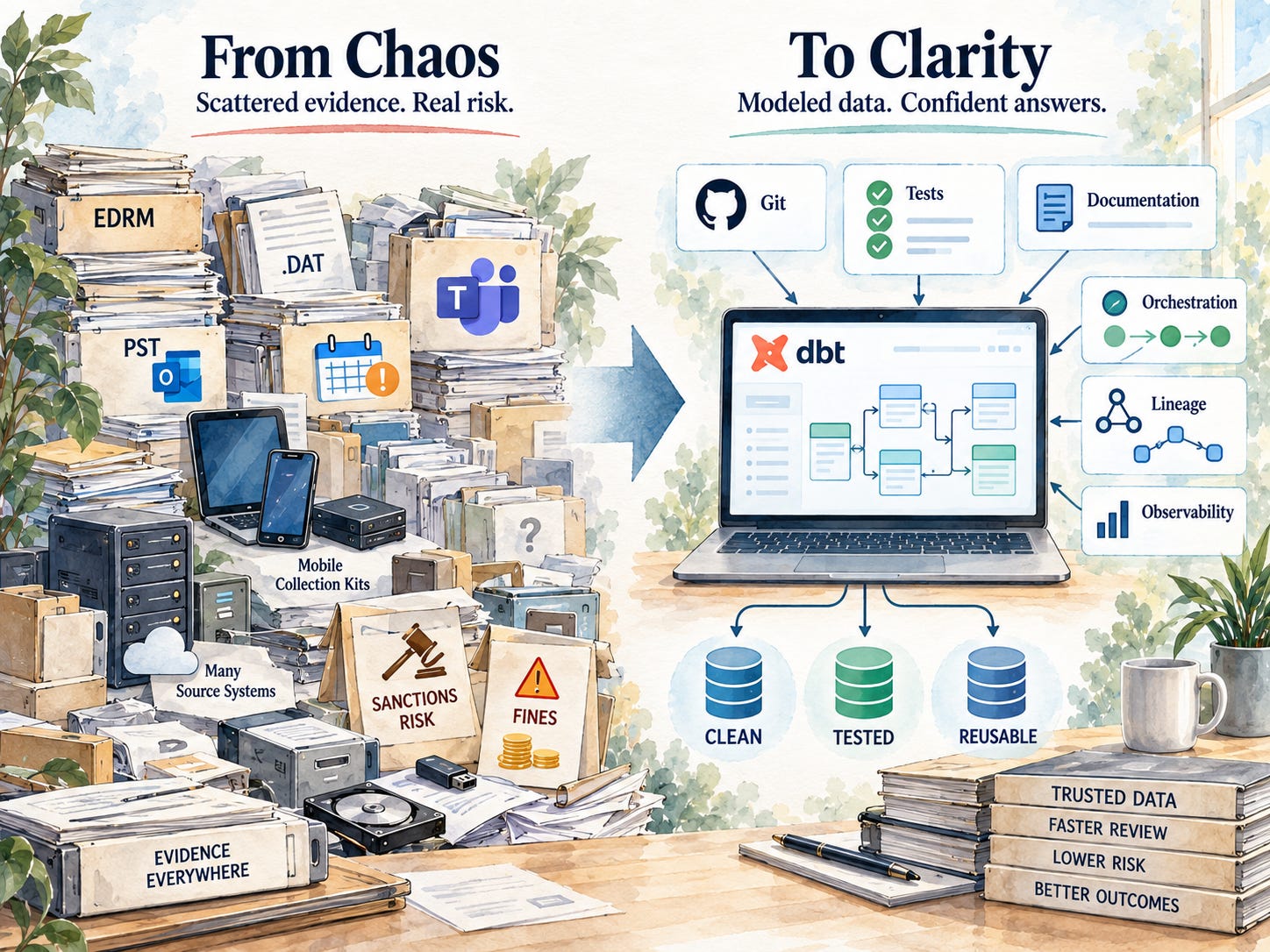
Instead of therapy, the tool I eventually found was closer to a weapon than a coping mechanism – dbt.
Suddenly the problems I already understood in my nervous system had modern solutions.
There is a word for what I had been living in, ephemeral, from the Greek ephēmeros: lasting a day. It also exists as a model type inside dbt itself. An ephemeral model produces no table and no view. It is pasted into whatever comes after it, as a CTE, and the only trace it leaves is inside somebody else’s compiled query. It exists once in your project and nowhere at all in your warehouse.
dbt’s version is deliberate: the table disappears, but the logic remains. Mine was backwards: the result survived, while the logic that produced it evaporated.
An artifact, from arte factum, is a thing made by skill which is also unearthed from within. dbt uses it for the JSON it writes, which has a way of getting stakeholders and leaders to finally commit to some consistency that no amount of asking (begging) ever did. The days of “which of these two revenue numbers is the real one” followed by “Ah yes, excellent question. Give me ten minutes for a quick scream while I battle these nested queries” were further behind me. I was finally able to reclaim some sanity alongside my sense of self and humor.
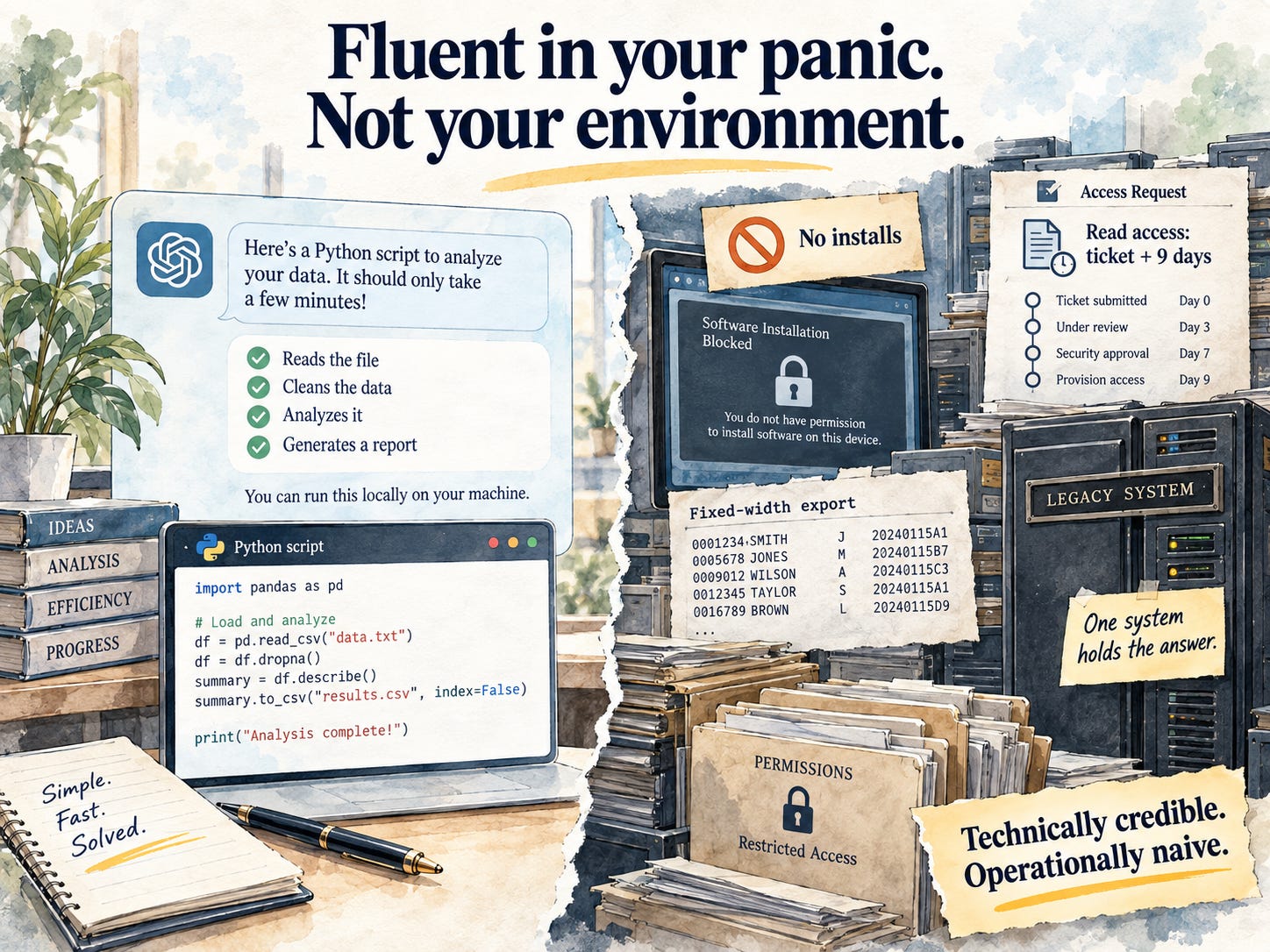
AI doesn’t know any of this and most likely neither do you (yet). It doesn’t understand that you can’t install anything, that read access takes a ticket and nine days, and that the one system holding the answer only exports to a fixed-width text file. It will cheerfully hand you a Python script. It has never done this work, so it has no idea what is expensive for you and what is trivial.
What it has instead is pathos. Your phrasing, your history, the shape of your eleven o’clock. That insidious combination produces something technically credible enough to be trusted and intimate enough with your desperation to be believed.
It isn’t the errors that make it a poor teacher. It’s that it is more fluent about your panic than about your environment (both technical and cultural). Which is close enough to the definition of an abusive learning environment that I’ll commit to it as somebody who spent a year inside one.
Most of what I’ve described is downstream of a permission you may not have and thankfully don’t need.
The waiting is the part that does the damage. Not the missing skill. The year you spend assuming there’s a gate is another year of enforcing a version of yourself that’s shaped to fit a room not a person the room has to answer to.
Nobody out there knows four times what you know; they have four times the surface area, superior methods and instincts. That’s the part no tutorial can give you, working inside a system that pushes back conditions a different set of reflexes over time, until you stop asking what the next step is and start reading the system for what it’s telling you.
… nobody was coming. So we built it and it’s yours now.
An environment that responds to what you do inside it. When you change a model, the dashboard moves under you. When ingestion breaks, your tests either catch it or they quietly don’t and finding out which is the lesson. Data shows up late, columns get renamed without warning, numbers stop reconciling and because you own every layer, you’re the one who traces it back and decide what to do.
The distance between analyst and the dignifying skills once reserved for engineers is far shorter than the curriculum industry needs you to believe.
Give yourself grace.
Ephemeral is a fine thing for a model to be. It is a terrible thing to be asked to be.
Found a gem against the gamified search engines
https://www.reddit.com/r/degoogle/s/SJ0MBqcly3